Perfect Binding vs Saddle Stitching: Which Is Right for Your Print Business?
If you run a print shop or manage an in-house print department, it’s certain that you must’ve faced the question of whether you should invest in a perfect binding machine, or if saddle stitching is more sufficient for your needs? Both methods produce professional-looking booklets and documents, but they serve different purposes, different markets, and different budgets.
In this guide, we break down exactly how each method works, what it’s best suited for, and how to decide which binding solution works best for your print shop. Whether you’re setting up a new finishing department or looking to expand what you currently offer, it’s crucial to understand the difference between these two methods as it is a solid starting point.
What Is Saddle Stitching?
Saddle stitching is one of the most common and cost-effective binding methods in print. Sheets of paper are folded in half and stapled along the spine helping create a booklet. Saddle-stitched products are very common. Examples include magazines, event programmes, small catalogues, and promotional brochures.
Saddle stitching is best used for:
- Magazines and periodicals
- Event programmes and flyers
- Small product catalogues (typically under 64 pages)
- Internal reports and newsletters
- Short-run promotional booklets
This type of stitching is quick, economical, and requires relatively straightforward equipment. However, its main limitation is page count. Too many pages in the booklet makes it difficult for them to be stapled cleanly, and this makes the spine start to splay outward rather than lying flat. Most industry guidance puts the practical upper limit at around 60 pages, though in reality, thicker paper stocks can cause problems well before that. For anything beyond that threshold, saddle stitching simply doesn’t deliver the clean, flat result that clients expect from a professional print product.
What Is Perfect Binding?
Perfect binding produces the flat, square-spined books you’d find in any bookshop, trade catalogue, or corporate report. Pages are gathered together into a text block, the spine edge is roughened or milled to create a better bonding surface, and hot-melt adhesive glue is applied to bond the pages securely to a wrap-around cover. The result is a clean, flat-spined book with a professional finish that can carry text, logos, or branding on the spine itself, something saddle stitching simply cannot offer.
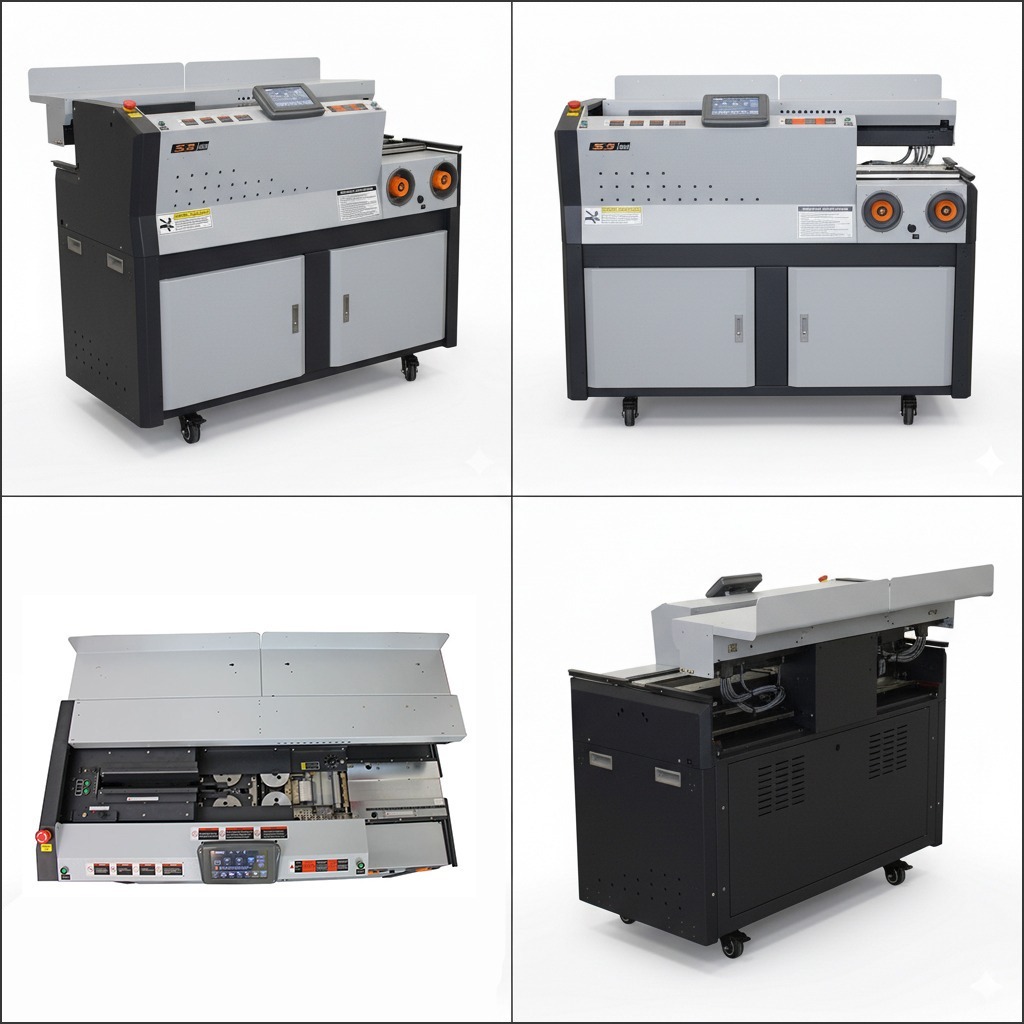
A perfect binding machine automates this process, thus allowing print businesses to produce high-quality bound documents in-house at scale, without outsourcing to a trade binder. Modern machines designed for small to medium print shops are compact, straightforward to operate, and capable of producing consistent, high-quality results across a wide range of document types and paper weights.
Perfect binding is best used for:
- Books and novels
- Annual reports and corporate documents
- High-end product and trade catalogues
- Student dissertations and theses
- Training manuals and course books
- Financial and legal documents
Perfect binding can handle far higher page counts — typically anything from around 60 pages upward — and produces a finished product that looks and feels premium. It also opens the door to a wider range of cover stocks and finishes, giving you and your clients greater creative control over the final product. If your clients want their documents to sit on a shelf or desk with authority, perfect binding is the answer.
Key Differences at a Glance
- Page count: Saddle stitching suits up to ~60 pages; perfect binding handles 60+ pages comfortably
- Spine: Saddle stitched = rounded/folded spine; Perfect bound = flat, printable square spine
- Finish: Both look professional, but perfect binding is perceived as more premium
- Cost per unit: Saddle stitching is cheaper per unit for low page counts; perfect binding becomes cost-effective at higher page counts
- Equipment investment: Perfect binding machines require a greater initial investment but deliver significantly higher value output
- In-house capability: Both can be done in-house — but perfect binding unlocks higher-value work
Which Should Your Print Business Choose?
The honest answer is that most established print businesses should offer both. Saddle stitching covers your high-volume, lower page count work efficiently. A perfect binding machine opens the door to a different tier of client, such as those producing books, premium catalogues, corporate reports, and bound academic work.
Ask yourself the following:
- Are you currently outsourcing any perfect binding work to a trade binder? If so, you’re paying a premium and losing turnaround control.
- Do your clients produce annual reports, training manuals, or catalogues? These are almost always perfectly bound.
- Is there demand in your area for student thesis binding? Universities generate steady, predictable volumes of perfect binding work.
- Do you want to offer a higher-margin service that competitors without the equipment cannot match?
If you answered yes to any of the above, a perfect binding machine is not just ideal, but it’s also a sound investment in your business’s capability and revenue potential.
The Case for Bringing Perfect Binding In-House
Many print shops start outsourcing their perfect binding jobs. It seems like the safe option as there’s no equipment cost and no setup time. But outsourcing comes with real downsides: you lose control of quality, turnaround times, and margins. Every job you send out is profit you’re handing to someone else, and every time a client needs a fast turnaround, you’re at the mercy of your trade binder’s schedule.
There’s also the matter of client relationships. When you bring perfect binding in-house, you become a more complete supplier. Clients who currently split their work between you and a trade binder no longer need to. That consolidation often means more volume, stronger loyalty, and less risk of losing the account to a competitor who can offer everything under one roof.
A modern perfect binding machine pays for itself relatively quickly when you consider the combined savings on outsourcing costs and the margin you retain on each job. Beyond the numbers, it also means faster turnarounds and the ability to handle rush jobs, both of which your clients will value. For many UK print businesses, the tipping point comes sooner than expected, particularly when thesis binding season hits or when a key client ramps up their catalogue output.
At GAPS UK, we supply perfect binding machines suited to small and medium print businesses that are straightforward to operate, built for consistent results, and backed by the support and warranty you’d expect. If you’re considering adding perfect binding to your offering, get in touch and we’ll help you find the right machine for your volume and budget.
Final Thoughts
Saddle stitching and perfect binding are not rivals, instead they complement each other. Saddle stitching handles your quick, cost-effective booklet work efficiently and economically. Perfect binding handles the jobs that command a higher price, leave a stronger impression, and keep clients coming back because you’re offering something not every print shop can deliver.
If your print business is ready to move beyond saddle stitching for the right jobs, a perfect binding machine is one of the most commercially useful pieces of kit you can add to your finishing department. It broadens your service offering, increases your margins, and positions your business as a serious, full-service print provider — rather than a shop that has to turn work away.
You can browse our Perfect Binding Machines at gapsuk.com or call us on 01376 335 150 to discuss your requirements.
Frequently Asked Questions (FAQs)
What is the difference between perfect binding and saddle stitching?
Perfect binding uses hot-melt glue to bond pages to a flat, square-spined cover, making it ideal for books, catalogues, and reports. Saddle stitching folds and staples pages along the spine, making it better suited to shorter booklets, magazines, and brochures. The key difference comes down to page count, finish quality, and the impression you want to leave.
How many pages do you need for perfect binding?
Perfect binding is generally recommended for documents of 60 pages or more. Below that threshold, saddle stitching is more practical and cost-effective. However, the exact minimum can vary depending on paper weight — thicker stocks may allow perfect binding at slightly lower page counts.
Is a perfect binding machine worth buying for a small print shop?
For most small print shops, yes — especially if you are currently outsourcing perfect binding work to a trade binder. Bringing it in-house with a perfect binding machine means retaining your margins, controlling turnaround times, and offering a higher-value service to clients without relying on a third party.
What products are made using perfect binding?
Perfect binding is used to produce books, novels, annual reports, corporate brochures, high-end product catalogues, training manuals, student dissertations, and legal or financial documents. Any document that needs a professional, shelf-ready finish with a printable spine is a strong candidate for perfect binding.
Can you perfectly bind in-house without outsourcing?
Yes. A desktop or tabletop perfect binding machine allows small and medium print businesses to produce perfectly bound documents entirely in-house. Modern machines are compact, easy to operate, and deliver consistent, professional results — removing the need to outsource to a trade binder and giving you full control over quality and delivery.