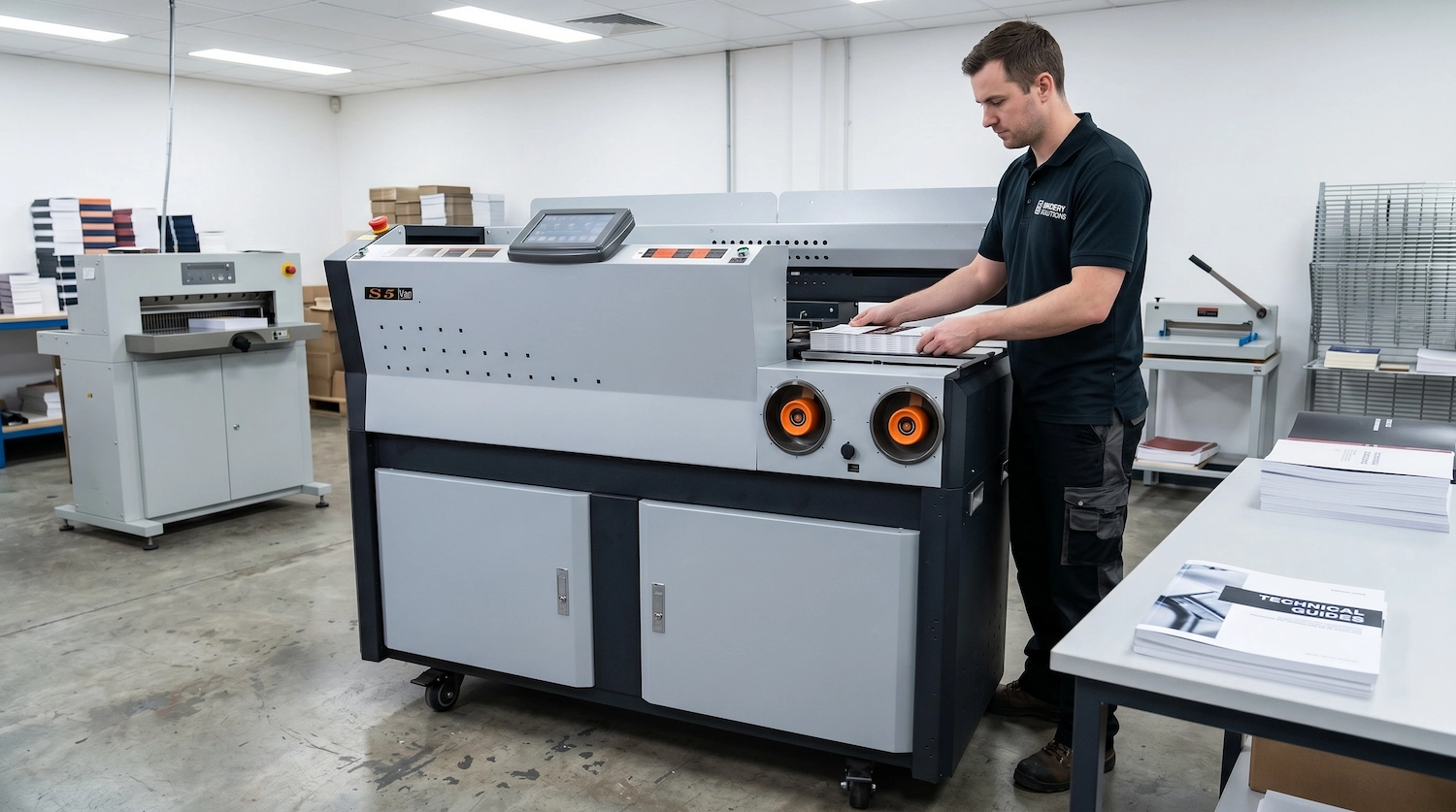
Perfect Binding Machine: The Complete Guide for UK Print Businesses
What if your printed books could look professionally published every single time?
Here’s the truth most print companies in the UK find out a little too late: The finishing is what makes all the difference between a client who comes back and one who doesn’t. And more often than not, it’s the binding they remember. Having the sharpest artwork and the best paper stock is not enough.
It’s a perfect binding machine which changes all of that. Whether you run a commercial print shop, an in-house print department, or a small finishing bureau, this guide will walk you through everything you need to know, starting from what perfect binding is, how it works, what to look for in a machine, and why UK businesses are increasingly investing in this technology to stay ahead.
What Is Perfect Binding?
Perfect binding is a professional book binding method that uses hot melt glue to attach a flat spine to gathered pages. The result? A square-spined, polished book that you often see on shelves in every bookshop across the country.
It’s the standard binding method used for:
- Paperback books and novels
- Catalogues and product brochures
- Annual reports and corporate documents
- Magazines and journals
- Manuals and technical documents
- Dissertations and academic submissions
Unlike saddle stitch binding (which uses staples and is only suitable for low page counts), perfect bound books can handle a much greater number of pages and offer a premium, flat-spine finish that’s ideal for professional print runs.
How Does a Perfect Binding Machine Work?
It is essential to understand the process of the binding machine to help us understand why investing in the right perfect book binding machine matters. Here’s a simple explanation of how the process works:
Step 1: Collating
Your printed pages are collected and bound together in a text block to help keep the book’s interior pages in order.
Step 2: Spine Roughening / Milling
The edge of the spine of the text block is roughened or milled. This provides an ideal surface for gripping.
Step 3: Glue Application
Hot melt glue (also known as perfect binding glue) is applied directly to the roughened spine. Products such as Planamelt perfect book binding glue are specially designed to create strong and flexible bonds which resist repeated use and handling.
Step 4: Cover Attachment
The printed cover is placed over the text block and pressed firmly against the glued spine. The cover is folded along the spine edges for a neat and clean fold.
Step 5: Trimming
Once the glue sets, the three open edges of the book are trimmed on a guillotine to ensure a clean and even finish.
From loose paper to a perfect bound book, the entire operation can be carried out in a few minutes by a modern machine.
Key Features to Look for in a Perfect Binding Machine
Not all perfect binders are created equal. When you’re evaluating options for your UK print business, here are the specifications and features that actually matter:
- Book Thickness Capacity – Most desktop and mid-range perfect binding machines handle spines from around 2mm up to 50mm or more. Make sure the machine you choose covers the range of jobs you typically produce.
- Clamp Capacity and Book Size – Check the maximum and minimum book dimensions the machine accepts. A good machine should comfortably handle A4, A5, and DL formats which are the most common sizes in UK commercial print.
- Warm-Up Time – Hot melt glue systems need time to reach operating temperature. Faster warm-up times (under 10 minutes) mean less downtime between jobs. This is particularly important in busy print shops.
- Cycle Speed – How many books per hour can the machine produce? Entry-level perfect binders may produce 80–100 books per hour, whilst production-grade machines handle far more. Match the output to your actual workload.
- Glue Tank Capacity and Compatibility – Larger glue tanks mean fewer top-ups mid-run. Ensure the machine is compatible with high-quality perfect binding glue as this directly affects bond strength and longevity.
- Ease of Use and Digital Controls – Modern perfect binding machines with digital displays and programmable settings make it far easier to train staff and maintain consistency across jobs. This is especially valuable in businesses with multiple operators.
- Build Quality and Reliability – For UK businesses, aftersales support matters as much as the machine itself. Look for suppliers such like GAPSuk who have been operating in the print finishing industry for over a decade and can offer genuine technical support.
Perfect Binding vs. Other Binding Methods: Which Is Right for You?
| Binding Type | Best For | Spine Finish | Page Count |
| Perfect Binding | Books, catalogues, reports | Flat, square spine | 28+ pages |
| Saddle Stitch | Magazines, booklets | No spine | Up to ~60 pages |
| Wire / Comb Binding | Manuals, notebooks | Coil/wire | Any |
| Case Binding (Hardback) | Premium books | Hardcover | Any |
For most UK print businesses, perfect binding hits the sweet spot. Not only is it fast, it’s also professional, cost-effective, and produces results client genuinely value.
The Role of Perfect Binding Glue
The glue is just as important as the machine. Perfect binding glue, such as the hot melt EVA adhesive must offer:
- Strong initial tack to grip the spine immediately
- Flexibility once cured, to prevent pages from cracking when the book is opened
- Consistent viscosity at operating temperature for even application
Planamelt perfect book binding glue, available from GAPSuk, is a trusted choice for UK businesses running both desktop and production-level binders. It’s formulated to work effectively with a wide range of paper stocks and cover materials, giving you confidence across every job.
Who Should Invest in a Perfect Binding Machine?
A perfect binder makes commercial sense for:
- Commercial print shops looking to bring finishing in-house and reduce outsourcing costs
- In-house print departments at universities, publishers, or large corporates
- Short-run digital printers offering personalised books, reports, or catalogues
- Photobook producers and photography studios
- Print-on-demand businesses need fast, consistent turnaround
If you’re currently outsourcing your perfect binding, there’s a strong chance you’re losing margin on every job. Bringing it in-house with the right machine can pay for itself surprisingly quickly.
Why UK Print Businesses Trust GAPSuk for Perfect Binding Machines
GAPSuk has been supplying print finishing machinery across the UK since 2011. Over a decade of working directly with print businesses means we know the pressures you face: tight margins, production deadlines, and equipment that simply has to work.
The Perfect Book Binding Machine in GAPSuk’s range is designed specifically for the demands of UK commercial print:
- Compact footprint suitable for most print rooms
- Easy digital controls for consistent results
- Compatible with Planamelt perfect binding glue
- Backed by a full warranty and UK-based technical support
Whether you’re a one-person operation or a busy production floor, there’s a solution that fits.
Call GAPSuk on 01376 335 150 or visit
gapsuk.com/perfect-book-binding-machine to find out more.
5 Common Mistakes to Avoid When Perfect Binding
Even experienced operators make these errors — avoid them and you’ll get better results from day one:
- Not roughening the spine adequately — poor milling means weak glue adhesion and books that fall apart
- Using the wrong glue temperature — too hot and the glue runs. Too cool and it doesn’t bond properly
- Not allowing sufficient cool-down time — rushing to trim before the glue has fully set causes delamination
- Ignoring paper grain direction — text block grain should always run parallel to the spine for best results
- Skipping routine maintenance — glue residue build-up in the tank affects consistency; clean regularly
Final Word: Is a Perfect Binding Machine Worth It?
For any UK print business handling catalogues, books, reports, or corporate documents, the answer is yes, absolutely.
The combination of professional results, quick turnaround, and the ability to bring finishing in-house makes a perfect binding machine one of the most commercially sensible investments you can make. Add a quality perfect binding glue to the mix, and you’ve got a setup that delivers consistent, impressive results on every job.
The businesses that are winning in UK print right now aren’t cutting corners on finishing. They’re investing in the right equipment, from the right suppliers, with the right support behind them.
Frequently Asked Questions (FAQ)
What is a perfect binding machine used for?
A perfect binding machine is used to bind books, catalogues, reports, brochures, and magazines by applying hot melt glue to the spine of a gathered text block and attaching a cover. It produces a professional square-spined finish.
How thick does a book need to be for perfect binding?
Most perfect binding machines require a minimum spine width of around 2–3mm to bind effectively. This typically corresponds to at least 28–40 pages (depending on paper weight). For thinner documents, saddle stitch or staple binding is usually more appropriate.
What glue is used in a perfect binding machine?
Hot melt EVA adhesive — commonly referred to as perfect binding glue — is used. Products like Planamelt perfect book binding glue are specifically formulated for use in desktop and production perfect binders, offering strong adhesion and flexibility.
How long does a perfect binding machine take to warm up?
Warm-up times vary by machine, but most desktop perfect binders reach operating temperature in 5–15 minutes. Higher-end machines with larger glue tanks may take slightly longer to heat evenly.
Can perfect binding machines handle short runs?
Yes — modern desktop perfect binding machines are well-suited to short-run and on-demand printing. They’re ideal for digital print environments where job quantities can range from a single copy to several hundred.
Is perfect binding durable?
When done correctly using quality glue and proper technique, perfect bound books are highly durable and suitable for everyday use. The flexibility of the cured glue allows the book to open flat without cracking along the spine.
Where can I buy a perfect binding machine in the UK?
GAPSuk supply perfect book binding machines across the UK, along with compatible Planamelt perfect binding glue. They’ve been operating since 2011 and offer full warranty and UK-based support. Call 01376 335 150 or visit gapsuk.com for more information.
What is the difference between perfect binding and saddle stitch binding?
Perfect binding produces a flat, square spine and is suitable for higher page counts (28+ pages). Saddle stitch uses staples through the fold and is best for thin booklets and magazines up to around 60 pages. Perfect binding delivers a more premium, professional finish.