Why Digital Controls & Programmable Systems Are Changing the Way Businesses Cut Paper and Why You Can’t Afford to Ignore It
Here’s something most people in the print and office industry don’t realise: the paper guillotine, a tool that’s been around for over a century, is now quietly going through one of the biggest transformations in its history. Businesses that are slow to notice this are already falling behind.
We’re talking about digital controls and programmable systems in electric paper cutters and guillotines. This isn’t just a fancy upgrade. It’s a fundamental shift in how print finishing machinery works. For businesses that rely on precise, high-volume cutting, it genuinely changes everything.
Whether you run a busy print shop, a design studio, a school, or a corporate office, it’s important for you to know about this trend. Let’s break it down.
What Are Digital Controls in Electric Paper Guillotines?
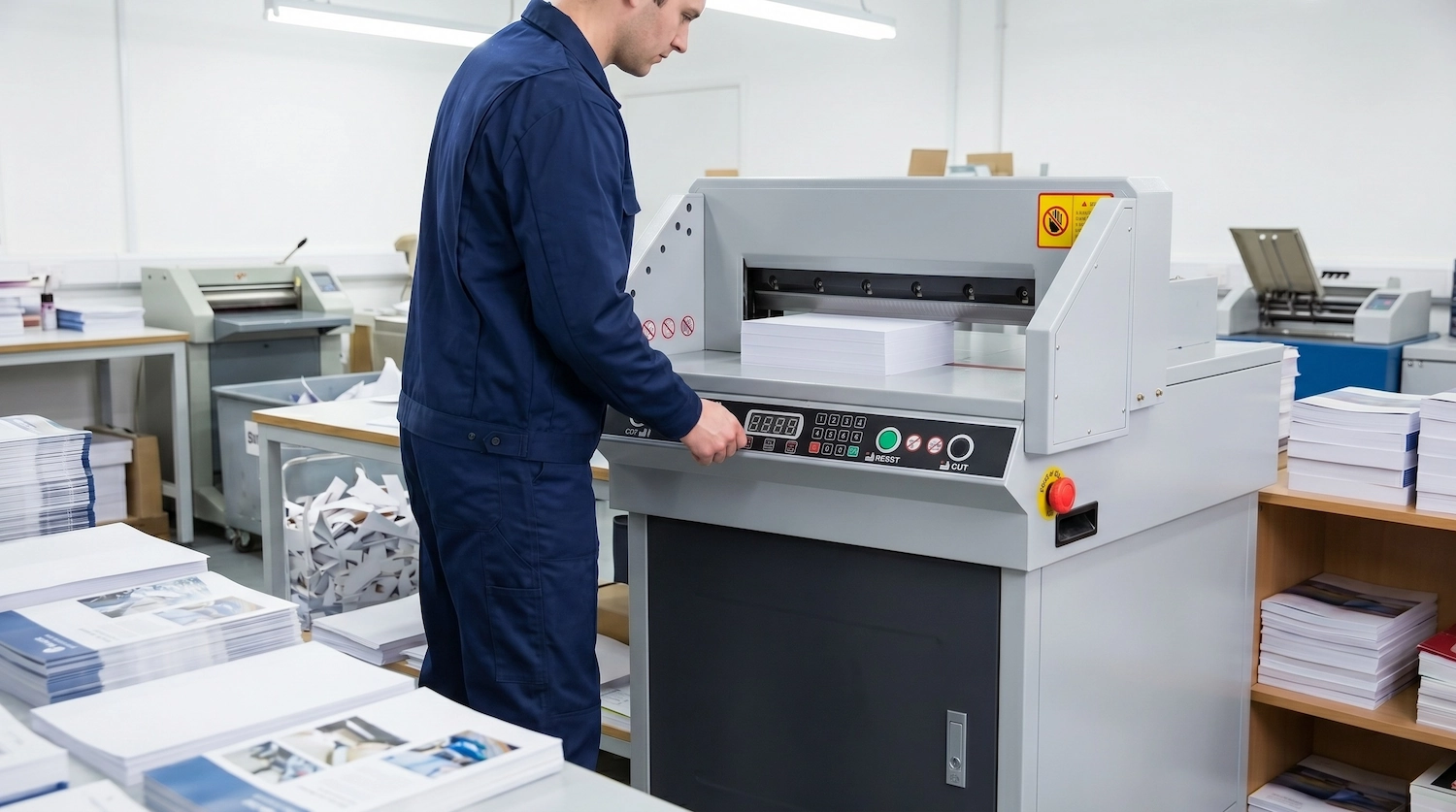
In plain terms, a digitally controlled electric paper cutter replaces manual levers, mechanical clamps, and guesswork with a programmable interface which is usually a digital display. It lets you set exact measurements, store cutting sequences, and repeat them with total consistency.
Rather than adjusting a backstop by hand and hoping for the best, you simply enter your measurement on a keypad. The machine moves to the precise position. You cut. It’s quick, it’s accurate, and it’s repeatable.
The newer generation of programmable electric guillotines takes this even further. You can store multiple cutting programmes, switch between them in seconds, and run through complex sequences without re-measuring after every cut. For anyone doing high-volume or repeat jobs, that’s a serious time-saver.
Why This Trend Is Accelerating Right Now
The market data backs this up strongly. The automatic paper cutter market was valued at over £900 million globally in 2024, and analysts have forecasted a compound annual growth rate of around 9% through to 2032. That’s not slow, steady growth. That’s rapid adoption driven by real demand.
So, what’s driving it?
- Businesses are under pressure to do more with less
Labour costs are rising. Time is tight. When a machine can remember your cutting sequences and execute them precisely, you free up skilled staff to focus on higher-value work rather than measuring and re-measuring every job by hand.
- Precision is non-negotiable in modern print finishing
Today’s clients expect perfection. A slightly off-cut on a run of business cards or wedding invitations isn’t acceptable. Digital controls on electric paper cutting machines eliminate the human error that mechanical systems are prone to.
- Safety standards are rising
Modern digitally controlled guillotines don’t just perform better, but they’re also safer. Features like infrared light beam safety guards, automatic blade locking, and power-off protection have become standard on quality machines. Operators are protected without sacrificing speed.
The Real-World Difference: A Programmable Guillotine vs. a Traditional One
Let’s be honest: if you’ve only ever used a traditional mechanical guillotine, the difference feels almost unfair.
With an older machine, every single cut requires manual adjustment. You move the backstop, check it against a ruler, cut, then repeat. For a complex job with multiple cut sizes, you might spend more time setting up than actually cutting. Mistakes creep in. Consistency suffers.
With a programmable electric guillotine, you set your sequence once. The machine does the rest. You can store those programmes and recall them next time the same job comes in. For print shops running repeat orders, this alone can save hours every week.
The GAPS UK 4606 Z5 Electric Paper Guillotine, for example, features a programmable digital display alongside a 460mm cutting width, making it ideal for medium to high-volume environments where consistency and speed are essential. It’s the kind of machine that pays for itself through saved time and reduced waste.
Key Features to Look for in a Digitally Controlled Electric Guillotine
If you’re considering upgrading your paper cutting equipment, here’s what to prioritise:
- Programmable Digital Display — This is the foundation. Look for a machine that allows you to store multiple cutting programmes and switch between them easily. The fewer steps between jobs, the better
- Infrared Safety Light Beams — This is not something just “nice-to-have”, instead it’s now considered best practice in workplace safety. Machines like the GAPS UK 450VS+ Electric Guillotine include infrared light beam guards as standard, ensuring the blade only activates when safe to do so
- Electric Backgauge Positioning — Automatic backstop movement means you’re not manually cranking anything into position. Enter the measurement and the machine will move precisely every time.
- Solid Cutting Capacity — Digital controls are only useful if the machine itself is built to handle real workloads. Look at the cutting width (typically 450mm–460mm for professional-grade office and print use) and the sheet capacity.
- Power-Off Protection — This is a safety-critical feature. If power is interrupted mid-cut, the machine should lock safely rather than completing a potentially dangerous action.
Who Benefits Most from Programmable Electric Paper Cutters?
Honestly? Almost anyone who cuts paper regularly at a professional level. But some sectors are seeing particularly strong returns. These include:
- Commercial Print Shops — High-volume, repeat-format jobs are where programmable systems really shine. Set your sequence for a business card trim job once; recall it every time that client reorders.
- In-House Corporate Print Rooms — Companies with internal reprographics teams are upgrading from ageing manual guillotines to electric models with digital controls, reducing the skill barrier and improving output quality.
- Educational Institutions — Schools and colleges often have non-specialist staff operating cutting machinery. Digital controls simplify operation significantly, and modern safety features reduce risk.
- Design & Marketing Agencies — Agencies producing presentation materials, mockups, and promotional print in-house benefit enormously from the precision that digital controls deliver.
- Binderies and Finishing Houses — Anywhere that print finishing is a core activity, programmable guillotines speed up workflows and improve consistency across long runs.
The Safety Angle Matters More Than People Realise
It’s worth dwelling on this for a moment, because it’s something businesses sometimes overlook when comparing electric paper cutters.
A guillotine blade is no joke. Traditional machines have caused countless workplace injuries over the decades not through negligence, but simply because the safety mechanisms were limited.
Modern digitally controlled electric guillotines have transformed this. Infrared light beam guards create an invisible safety barrier across the cutting area. If anything, such as a hand, a piece of cloth, or anything else ends up entering that zone during operation, the machine stops. The power-off protection we mentioned means unexpected interruptions don’t result in dangerous mid-cycle blade movement.
For businesses subject to health and safety compliance requirements, these aren’t optional extras. They’re essential. And frankly, the peace of mind for anyone operating the machine day in, day out is genuinely valuable.
Is It Worth the Investment?
This is the question everyone asks, and it’s a fair one. A quality programmable electric paper guillotine is a meaningful investment, and it typically ranges from around £1,200 to £3,000 for professional-grade machines.
But think about it in terms of what you’re actually buying:
- Faster throughput on cutting jobs
- Fewer errors and less wasted paper/materials
- Reduced operator fatigue
- Lower training overhead for new staff
- Improved workplace safety compliance
- Consistent output quality that reflects well on your business
When you add those up, the return on investment for most commercial and professional environments is relatively quick. Continuing to operate older, slower, and less accurate equipment can also lead to hidden costs, including wasted time, material waste, and potential safety liability.
Why GAPS UK?
GAPS UK has been supplying print finishing machinery to businesses across the United Kingdom for years. We’re based in Braintree, Essex, and we supply directly, meaning no unnecessary middlemen and straightforward, honest advice about what equipment genuinely suits your needs.
Our range of electric paper cutters and guillotines, including the 450VS+ and the 4606 Z5 reflects exactly the trends we’ve discussed in this blog. Infrared safety systems. Programmable digital controls. Solid build quality designed for real professional use.
We’re not here to sell you the most expensive machine on the shelf. We’re here to help you find the right one.
If you’d like to discuss which electric guillotine is the right fit for your operation, get in touch with the team at GAPS UK. We’re always happy to have a straightforward conversation.
Frequently Asked Questions (FAQs)
What is a programmable electric paper guillotine?
A programmable electric paper guillotine is a paper cutting machine that uses a digital control system — typically a keypad and display — to set precise cut measurements and store multiple cutting programmes. Rather than adjusting the backstop by hand for each cut, the operator enters dimensions digitally, and the machine positions itself automatically. This dramatically reduces setup time and improves cutting consistency across repeat jobs.
How does a digital control system on an electric guillotine improve accuracy?
Digital controls eliminate the human error inherent in manual measurement and adjustment. When you enter a measurement digitally, the machine’s electric backgauge moves to that exact position with precision down to fractions of a millimetre every time. There is no guesswork, drift, or variation between cuts. For precision print finishing work, this level of consistency is essential.
Are electric paper cutters with infrared safety guards safer than traditional guillotines?
Yes, significantly. Infrared light beam guards create an invisible safety barrier across the cutting area. If any object, including an operator’s hand, enters the danger zone during a cutting cycle, the machine halts immediately. Combined with features such as power-off protection and automatic blade locking, modern electric guillotines represent a major improvement in workplace safety compared to traditional mechanical machines.
What cutting width do I need for a professional electric paper guillotine?
For most commercial print, office, and finishing applications, a cutting width of 450mm to 460mm covers the vast majority of requirements, including A3, A4, and SRA3 paper stock. Machines like the GAPS UK 450VS+ (450mm) and the 4606 Z5 (460mm) are designed specifically for this professional sweet spot. Larger-format work may require machines with a wider cutting capacity.
How many cutting programmes can a programmable guillotine store?
This varies by model, but quality professional-grade electric guillotines typically allow you to store anywhere from 10 to 99 individual cutting programmes. The GAPS UK 4606 Z5, for example, features a programmable digital display designed for multi-step cutting sequences, making it ideal for repeat jobs and complex cutting patterns.
Is an electric paper guillotine suitable for cutting cardstock and thick materials?
Yes, professional electric guillotines are designed to cut not only standard paper but also cardstock, laminated sheets, labels, and other heavier media. Always check the manufacturer’s specifications for maximum cutting thickness and material compatibility. The GAPS UK electric guillotine range is built for genuine professional workloads rather than lightweight office paper alone.
How do I choose between the GAPS UK 450VS+ and the 4606 Z5?
The 450VS+ is an excellent choice for businesses needing a reliable, capable electric guillotine with infrared safety guards at a more accessible price point (£1,275). The 4606 Z5 (£2,795) offers the additional benefit of a programmable digital display and 460mm cutting width, making it better suited to higher-volume environments or operations with complex, repeat cutting sequences. If you’re unsure, the GAPS UK team is happy to advise based on your specific workload.